
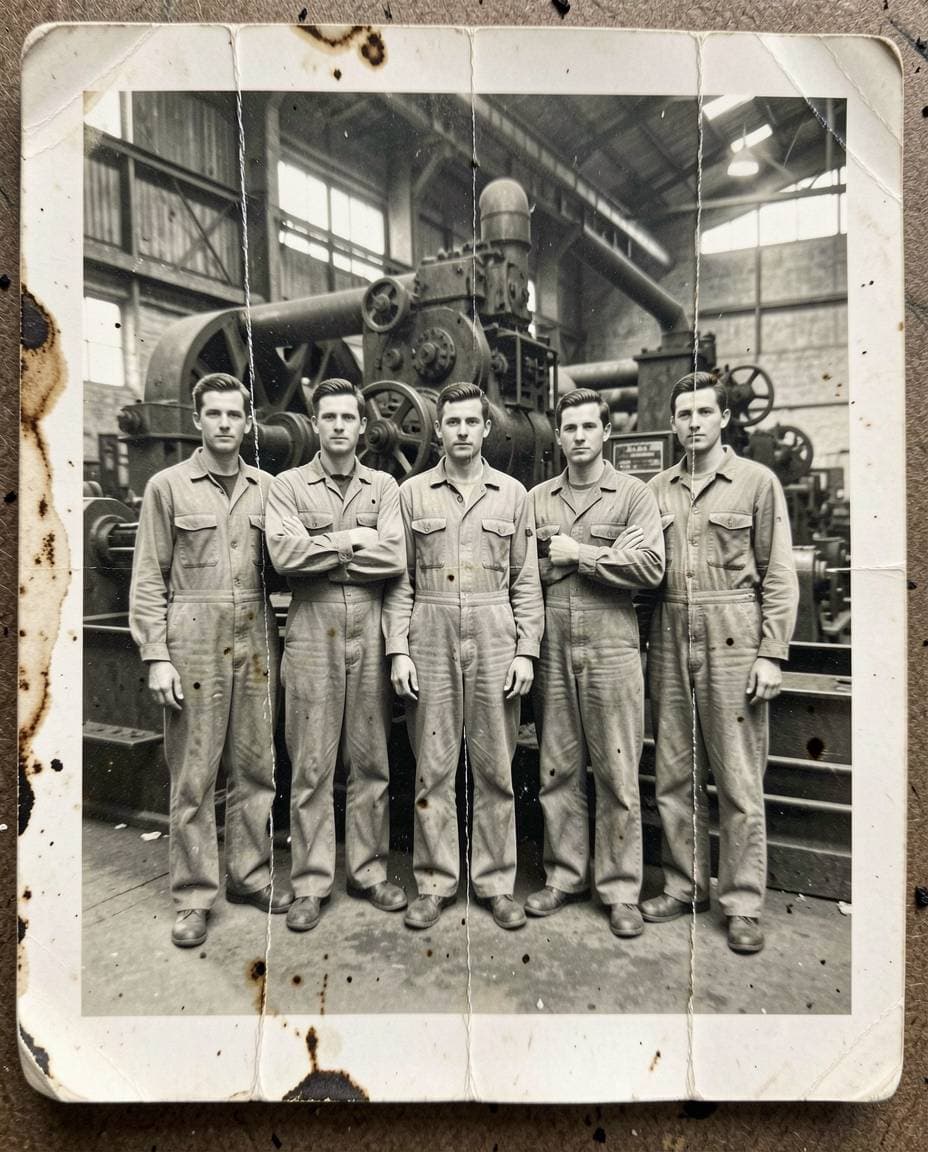
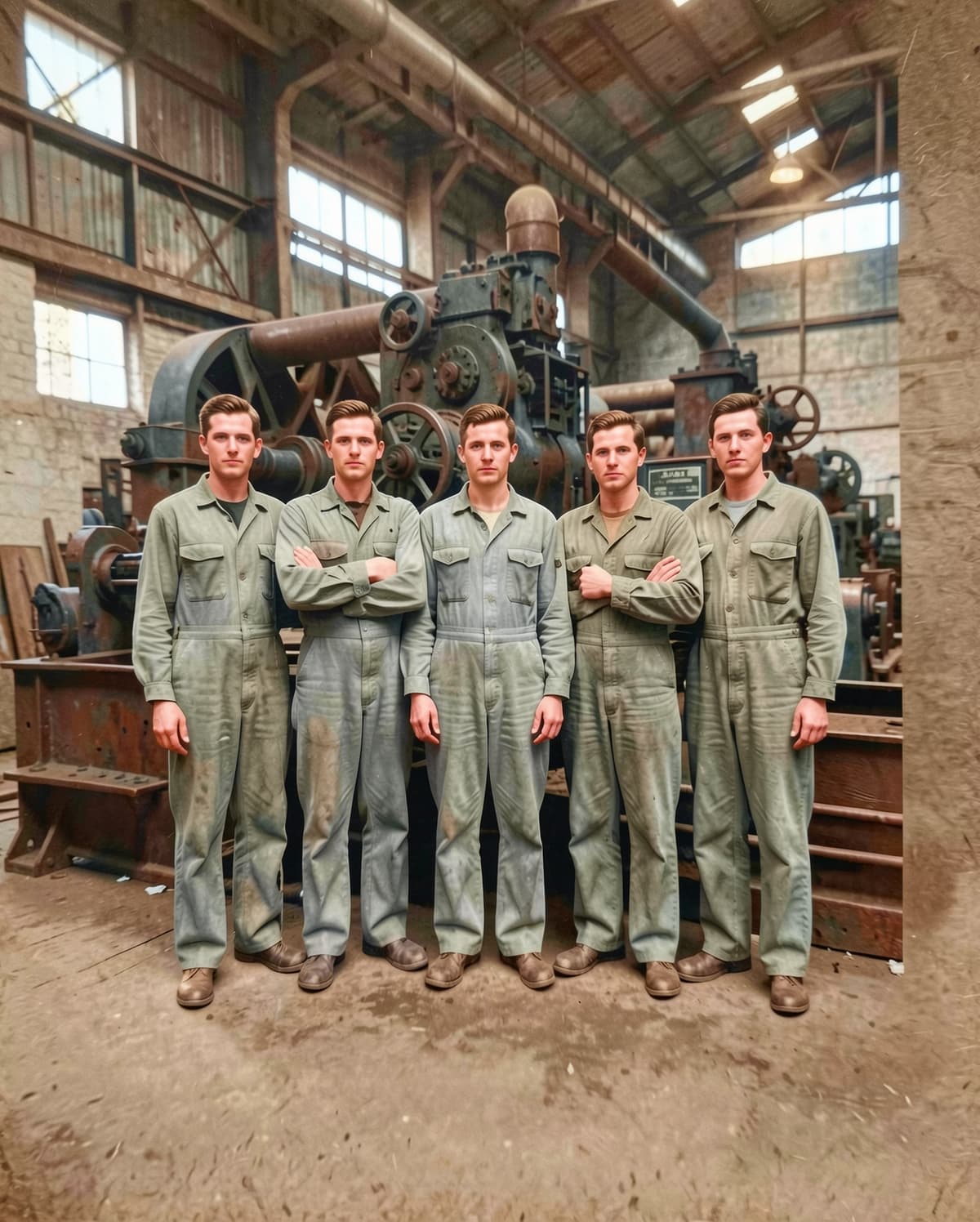
The photograph came from a metal lunchbox. His grandmother had kept it in the attic for decades alongside her late husband's work boots and a folded union card. Inside the lunchbox, wrapped in wax paper, was a black-and-white photograph showing a group of men and women standing in front of heavy machinery on a factory floor. His grandfather was in the front row, third from the left, wearing coveralls and a cap pushed back on his head. It was taken sometime in the mid-1940s at the textile mill where he had worked for twenty-seven years. The photograph was in rough shape, but the grandson wanted to have it restored for a family history project he was putting together for his children.
The Damage: Oil, Water, and Time
Factory photographs from the 1940s were working documents. They were pinned to bulletin boards, passed around break rooms, and stored in lockers and toolboxes alongside greasy rags and metal parts. This particular print bore the evidence of that life. Dark oil stains covered the lower right corner, obscuring two of the workers and part of the machinery behind them. The stains had soaked into the paper base, not just sitting on the surface but penetrating deep into the fibers and discoloring the emulsion from beneath.
A tear ran from the top edge downward for about two inches, splitting the image through the upper portion of the factory interior. The tear had been taped at some point with a piece of cellophane tape that had since yellowed and dried, leaving a sticky amber residue that created its own stain alongside the tear. A second, smaller tear notched the left edge where the photo had caught on something, probably the metal lid of the lunchbox it had been stored in for so long.
Beyond the stains and tears, the overall image had aged in the way that all gelatin silver prints age when stored in hot attics. The contrast had diminished, the blacks had turned to dark grays, and the highlights had yellowed slightly. The factory interior, which should have shown the dramatic contrast of industrial lighting, bright spots under overhead lamps and deep shadows between machines, had flattened into a murky middle tone that made it hard to read the spatial depth of the scene. The faces of the workers were visible but lacked the sharpness and definition needed to truly see the individuals in the group.
The Restoration: What ClearPastAI Fixed
The photograph was carefully removed from the wax paper, scanned at high resolution, and loaded into ClearPastAI. The AI identified the three main categories of damage: stains, tears, and overall degradation, and addressed each one.
The stain removal was the most demanding task. The oil stains in the lower right corner had deeply discolored the emulsion, and the AI had to distinguish between the natural dark tones of machinery and clothing and the unnatural darkness of the stain. It lifted the oil damage layer by layer, revealing the two workers who had been almost completely hidden. Their coveralls, their postures, and their faces emerged from behind the stain as though a curtain had been pulled back. The tape residue along the tear was cleaned away in the same pass, removing the amber discoloration without disturbing the surrounding image.
The tear repair reconstructed the missing strip of image along the top of the photograph. The factory ceiling, the upper portions of the machinery, and the overhead lighting fixtures were rebuilt based on the context of the surrounding image. The smaller tear on the left edge was similarly closed and filled. Both repairs were seamless, with no visible seams or differences in grain texture between the original and reconstructed areas.
The contrast and detail recovery brought the factory floor to life. The industrial lighting returned, casting bright pools under the overhead lamps and creating deep shadows between the rows of machines. The massive looms and drive shafts gained their metallic texture and mechanical complexity. The workers' faces sharpened into distinct individuals with visible expressions, some looking directly at the camera, others caught mid-conversation, one man in the back row grinning broadly with his arm resting on a lever.
Why This Matters: Honoring Working Lives
Factory workers of the 1940s rarely had their photographs taken professionally. The images that survive are candid shots, group photos on the factory floor, snapshots during lunch breaks, and the occasional posed portrait for a company newsletter. These photographs document a way of life that defined entire communities. The textile mills, steel plants, and assembly lines employed generations of families, shaped the rhythms of daily life, and built the middle class. When the mills closed and the factories moved, the photographs became the primary record of what that work looked like from the inside.
The grandson who found this photo in his grandfather's lunchbox had grown up hearing stories about the mill. He knew that his grandfather had started there at seventeen and retired at forty-four when the plant downsized. He knew the names of some of the coworkers, repeated so often in family stories that they felt like distant relatives. But he had never seen their faces until the restored photograph made them visible again. Matching names to faces turned oral history into something concrete and real.
He included the restored photo in the family history project alongside the union card and a copy of his grandfather's final pay stub. His children, who had never set foot in a textile mill and never would, could now see the place where their great-grandfather spent the best years of his working life, standing among the people he worked beside, in front of the machines he operated every day. Industrial heritage is often overlooked in favor of more picturesque history, but for the families who lived it, these photographs are as meaningful as any portrait in a gilded frame.

Restore Your Vintage Photos Today
Whether it is a stained factory photo or a torn workplace snapshot, ClearPastAI can recover the detail and clarity your heritage photos deserve. Try it free on your iPhone or iPad and bring your family's working history back to life.
Free to try. No account required.