
He found it folded in thirds inside a letter his grandfather had mailed home from the county fair in 1946. The photograph showed the family farm at the height of summer: a white clapboard house, a weathered barn, rows of corn reaching toward the horizon, and his great-grandparents standing beside a tractor with their sleeves rolled up. It had been folded into an envelope eighty years ago and had not been unfolded since. The creases were deep, the image had faded to a pale ghost of itself, and the man holding it knew this was the only photograph of the original homestead before it was sold in 1958.
The Damage: Folded Away for Eight Decades
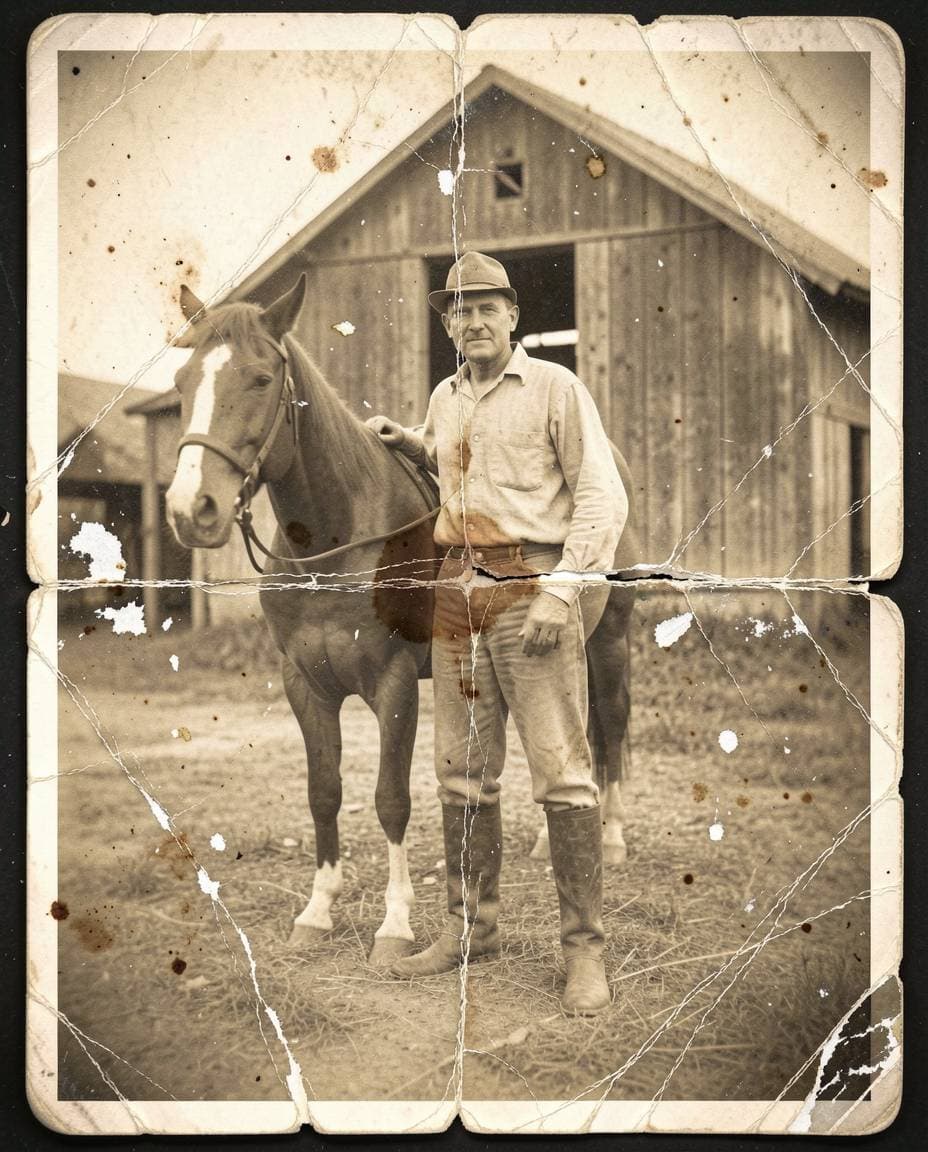
The print was a standard black-and-white snapshot from the 1940s, likely taken with a Kodak Brownie or a similar consumer camera of the era. It had been printed on thin, single-weight photographic paper, which made it easy to fold but also made it extremely vulnerable to creasing. The two fold lines ran straight across the image, one cutting through the barn and the sky above it, the other running across the foreground where the couple stood beside their tractor.
Along each crease, the photographic emulsion had cracked and separated from the paper base, leaving bright white lines that interrupted the image like scars. In several spots along the folds, small flakes of emulsion had broken away entirely, creating tiny gaps where the image was simply missing. The overall fading was severe. What should have been rich contrast between a white farmhouse and dark barn timbers had flattened into an almost uniform gray. The corn rows in the background were barely visible. The faces of the couple were soft and indistinct, as though seen through frosted glass.
Scanning the photo revealed additional damage that was hard to see with the naked eye. Fine surface abrasions from the paper it had been folded against covered the print in a haze of tiny marks. The corners were rounded and worn from sitting inside an envelope for decades. The overall impression was of an image that was slowly disappearing, its details sinking further into the gray with each passing year.
The Restoration: What ClearPastAI Fixed
The scanned image was processed through ClearPastAI on an iPhone. The AI identified the multiple types of damage and addressed each one in sequence.
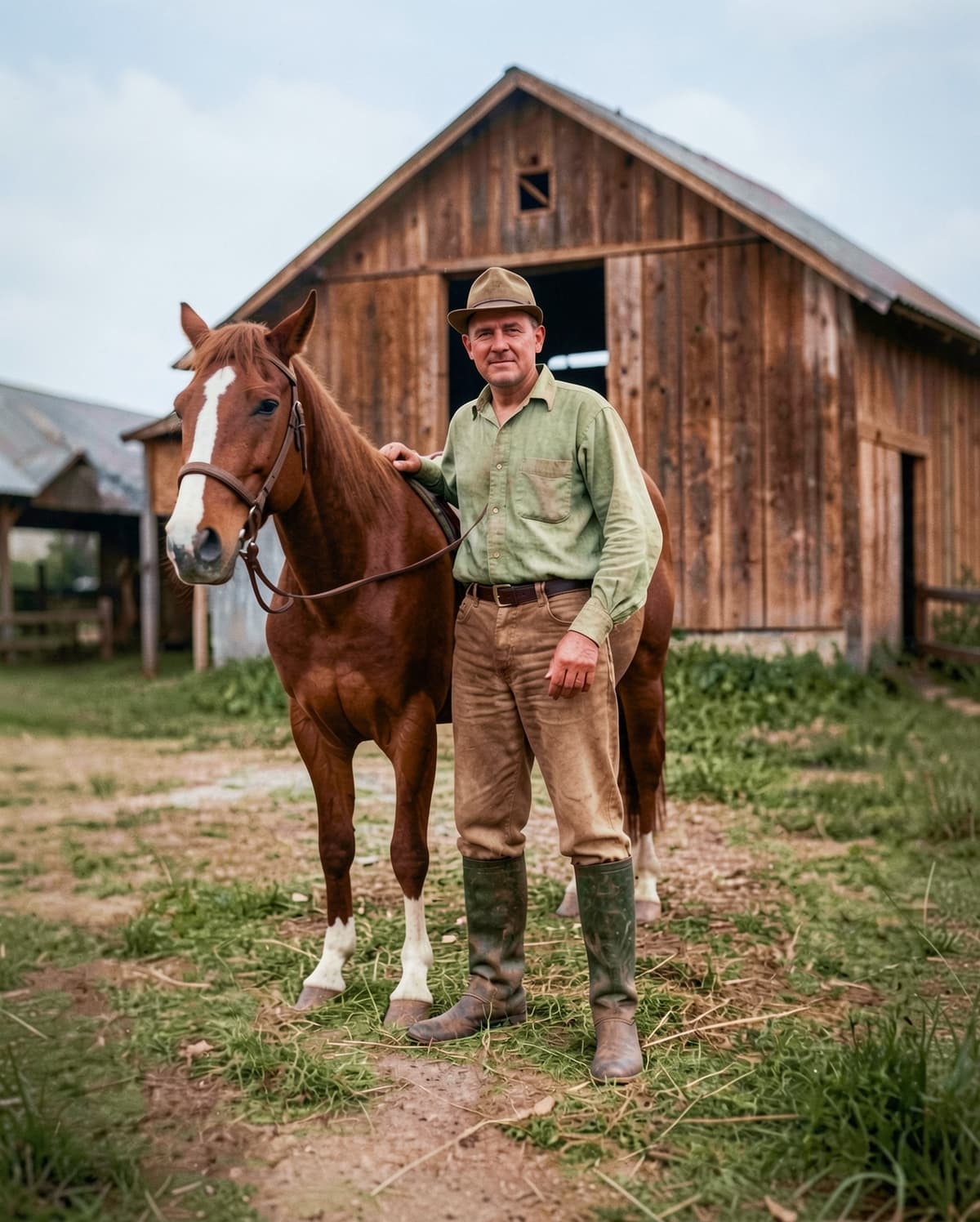
The crease repair was the most critical step. The AI traced each fold line across the image, identified the cracked and missing emulsion, and reconstructed the underlying detail. Where the fold cut through the barn, the weathered wood siding was rebuilt plank by plank, matching the grain and tone of the surrounding area. Where it crossed the figures, the fabric of their clothing and the contours of their faces were filled in with detail that blended seamlessly into the original image. The result was not a smudge or a blur over the fold lines but a genuine reconstruction of what had been underneath.
The contrast recovery transformed the flat gray field back into a photograph with depth and presence. The farmhouse glowed white against a deep sky. The barn timbers darkened to their proper rich tone, and the texture of weathered wood became clearly visible. The corn rows in the background separated from the sky and stretched out in neat lines toward the horizon. The tractor gained its metallic sheen and mechanical detail.
Most importantly, the faces of the great-grandparents came into focus. The soft, indistinct shapes resolved into two people with clear expressions, squinting slightly in the summer sun, standing proudly beside the machine that worked their land. Their rolled-up sleeves, the set of their shoulders, the way they stood close together all became readable details instead of vague suggestions in a faded print.
Why This Matters: The Land Remembers
Farm families built their lives around the land, and when the land is sold or the farm changes hands, the photographs are often the only record of what that life looked like. This particular homestead was sold in 1958, and the buildings were eventually torn down to make way for a housing development. Nothing remains of the original farm except memories, family stories, and this single photograph that was folded into a letter and forgotten in a drawer.
The grandson who found it said he drove past the old property every week on his way to work. He had always known the general area where the farm had been, but he had never seen what it actually looked like. Seeing the restored photo with the farmhouse, the barn, the tractor, and his great-grandparents standing in the middle of it all gave him a tangible connection to a family history he had only known through oral tradition. He printed the restored version and framed it next to a current aerial map of the area, creating a before-and-after of the land itself.
Agricultural heritage is disappearing faster than almost any other form of family history. The farms are consolidated or developed, the equipment is scrapped, and the people who worked the land pass on. Photographs are the bridge between that world and this one, and when those photographs deteriorate, the bridge weakens. Restoring them is a way of keeping the connection alive.

Restore Your Heritage Photos Today
Whether it is a creased farm photo or a faded snapshot of rural life, ClearPastAI can bring your agricultural heritage back into focus in seconds. Try it free on your iPhone or iPad and preserve the history that matters to your family.
Free to try. No account required.