
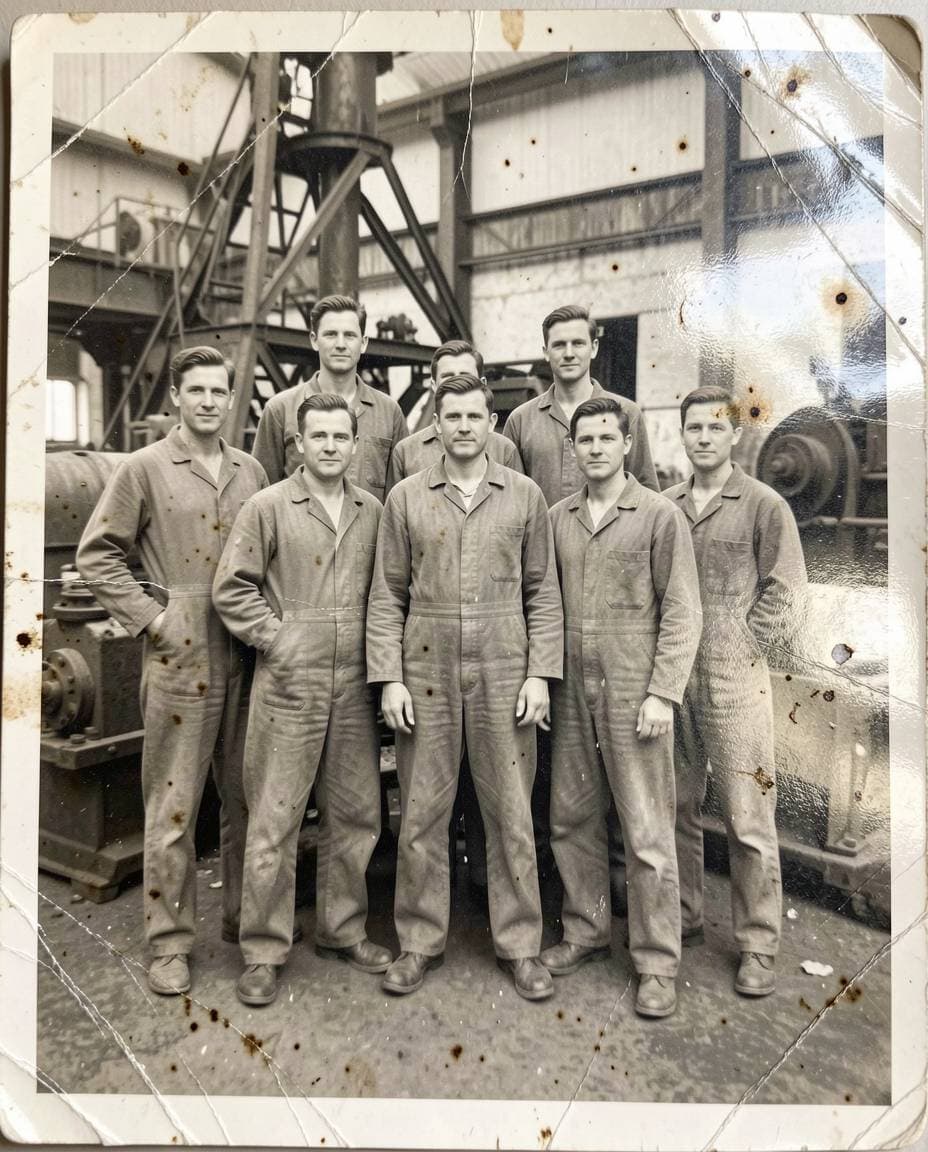
The photograph was found in a rusted tin lunch box at an estate sale. It showed a group of men and women standing in front of an industrial building, their work clothes dusted with grime, their faces tired but composed. On the back, someone had written in pencil: "Crew, Plant 4, October 1943." The buyer did not know these people. But she recognized the building -- it was the old manufacturing plant on the edge of her town, the one her grandfather had worked at before it closed in the 1970s. She bought the lunch box for three dollars and brought the photograph home.
The Problem: Stains and Tears from a Hard Life
Factory photographs from the 1940s did not receive the careful treatment given to studio portraits. They were working documents, taken quickly and stored carelessly, often in the same environments that damaged them. This photo had spent decades inside a metal lunch box that was not airtight, not climate-controlled, and not dry. The result was a print that bore the marks of industrial neglect.
Dark stains spread across multiple sections of the image, likely from moisture that had condensed inside the tin over years of temperature changes. The stains were not uniform -- some areas showed faint discoloration while others were so dark they completely obscured the workers beneath them. A chemical residue, possibly from contact with something else stored in the lunch box, had left a yellowish film across the lower third of the print.
Two tears ran through the photograph. One started at the top edge and extended downward through the factory's roofline. The other cut horizontally across the row of workers, separating some of them from the group. The tears had ragged edges where the paper fibers had pulled apart, and small pieces of the image were missing entirely along the tear lines. Between the stains and the tears, nearly half the photograph was compromised.
The Restoration: Before and After
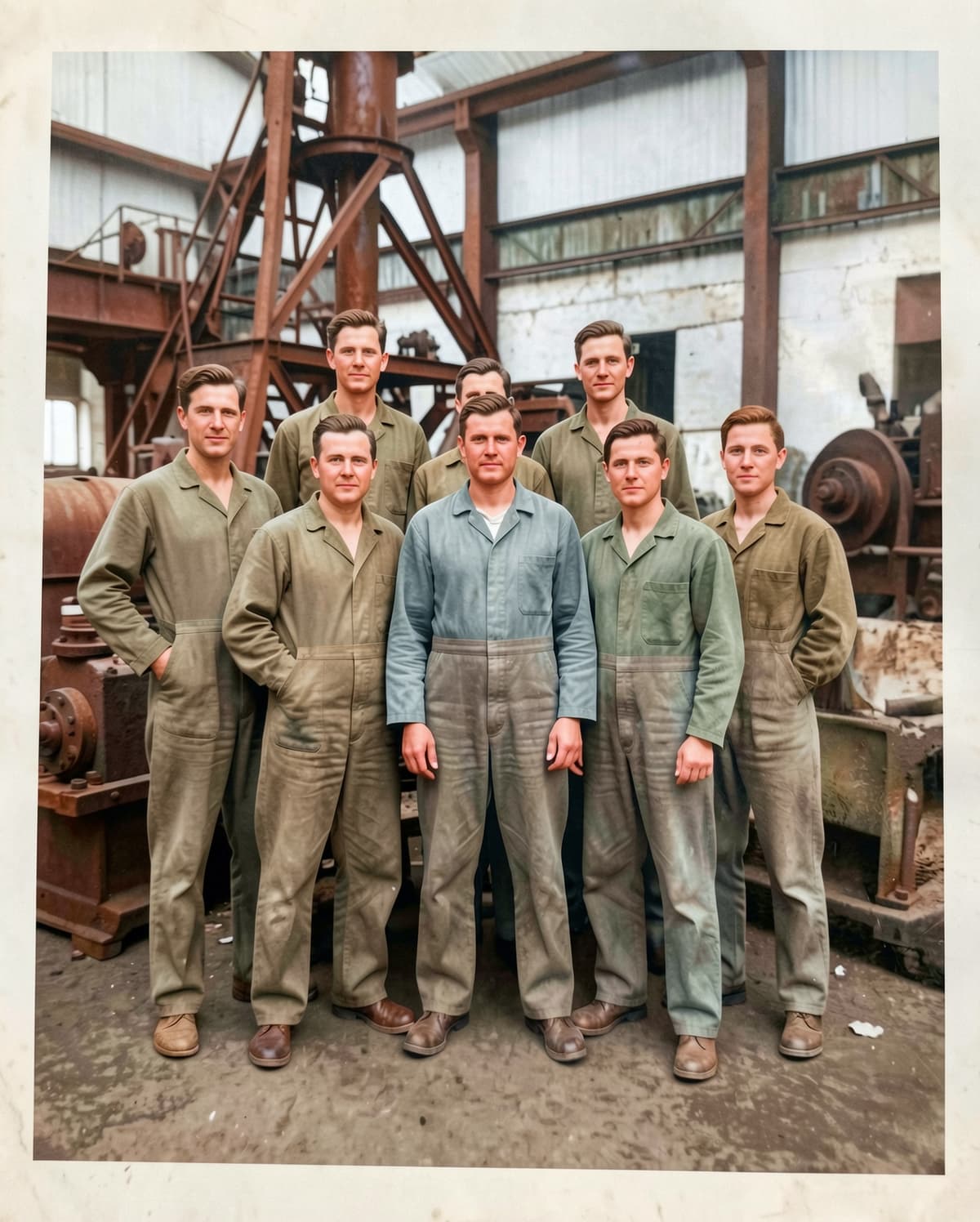
Here is the factory worker photograph before and after restoration with ClearPastAI. The stains have been removed, the tears repaired, and the full scene of the workers and their workplace has been recovered.
What ClearPastAI Fixed
The stain removal was the first priority. The AI mapped each stained region and separated the discoloration from the image content beneath it. Where the stains were lighter, the original detail emerged almost immediately -- faces, clothing, the brickwork of the factory wall. Where the stains were heavier and had partially dissolved the emulsion, the AI reconstructed the missing information using context from the surrounding areas and its understanding of what factory scenes, work clothing, and human figures look like.
Repairing the tears required a different approach. The AI identified the tear lines, including the ragged edges and the small gaps where paper was missing, and filled them in with generated content that matched both sides of the break. The vertical tear through the roofline was rebuilt with brickwork and window details consistent with the rest of the building. The horizontal tear through the row of workers was more delicate -- the AI had to reconstruct portions of clothing, hands, and in one case, part of a face, using the available information from the intact portions of the image.
The yellowish chemical film was corrected as well, restoring the neutral tones of the original black-and-white print. With the stains lifted, the tears sealed, and the tones corrected, the full group of workers became visible as a unified image for the first time in decades.
Why This Matters
Working people have always been underrepresented in family photo collections. Studio portraits cost money, and factory workers in the 1940s were not spending their wages on professional photography. The photos that do exist from these workplaces are often the only visual records of the people who built the infrastructure, manufactured the goods, and powered the economy of their era. When these images deteriorate, a piece of labor history disappears with them.
The woman who found this photograph could not identify her grandfather in the image with certainty -- the stains had obscured too many faces. After the restoration, she compared the cleared faces to another photograph she had of him from the same period. There he was, third from the left in the back row, standing with the people he spent his days alongside. She had never seen a picture of him at work before.
She donated a copy of the restored image to the local historical society, where it now hangs in a display about the town's industrial past. The workers in the photo finally have what they were never given in their own time: a clear, lasting record of their presence and their labor.

Preserve Your Family's Working Heritage
ClearPastAI removes stains, repairs tears, and restores the clarity of photographs that document your family's history. Try it free on your iPhone or iPad and honor the people who built your story.
Free to try. No account required.