
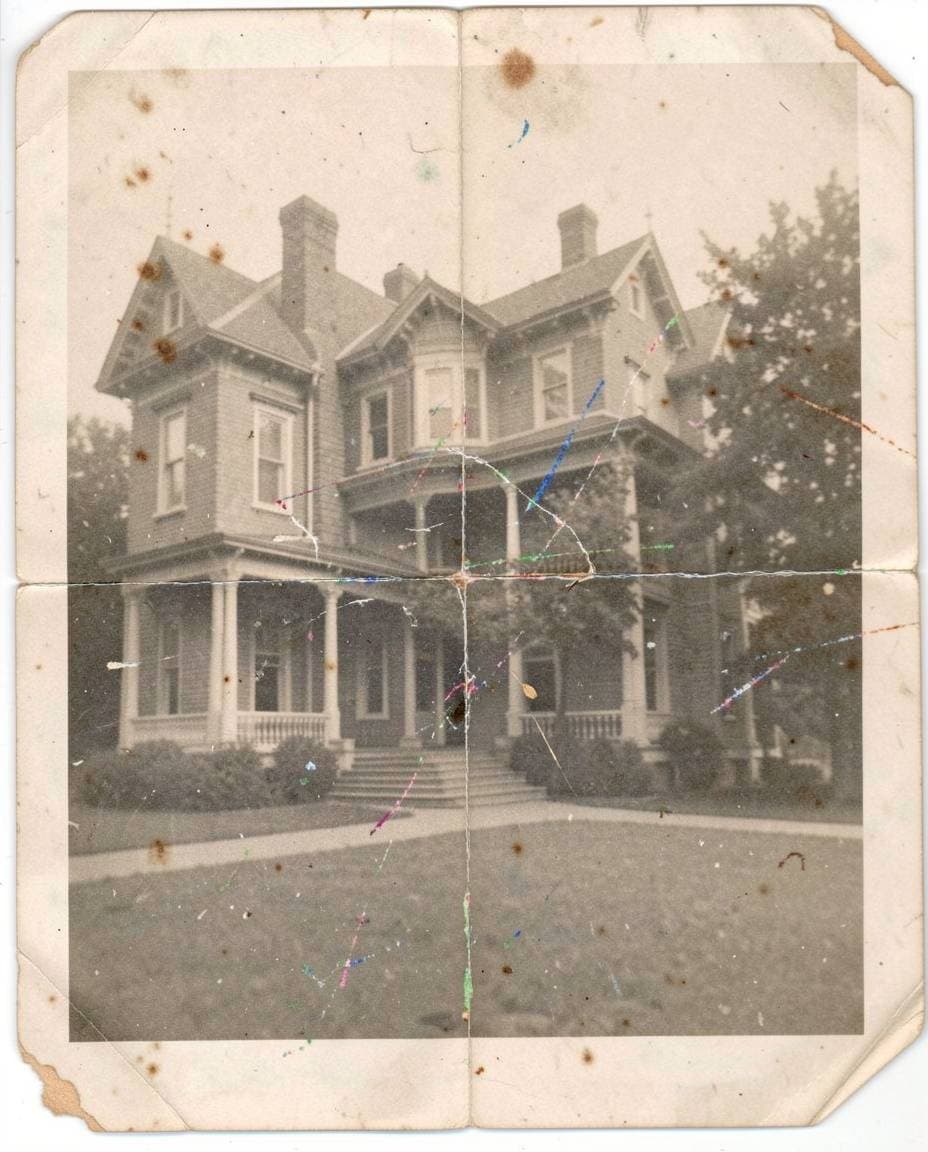
Tucked inside a manila envelope, behind a stack of yellowed property deeds, sat a single photograph of a house that no longer exists. The family who brought it to our attention had inherited the image along with everything else when their grandmother passed. It was the only surviving picture of the home where she had grown up during the 1920s, a stately clapboard house with a wide front porch and two towering elm trees flanking the walkway. The photograph itself, though, had seen better days.
A Century of Wear on Paper
The image was printed on heavy photographic stock, the kind common in professional portrait studios of the early twentieth century. Over its hundred-year lifespan, the paper had absorbed moisture from decades of storage in a non-climate-controlled attic. Brown foxing spots had bloomed across the surface, clustering heavily around the sky and the lighter areas of the house facade. The overall exposure had faded dramatically, reducing what was once a high-contrast black and white print to a washed-out ghost of itself. Architectural details that would have been clearly visible when the photograph was new, like the decorative trim along the roofline and the pattern of the porch railings, had receded into a uniform gray haze.
The foxing was particularly frustrating. Those rust-colored spots are caused by fungal growth or iron oxidation in the paper fibers, and they are nearly impossible to remove from a physical print without risking further damage. Traditional restoration would involve hours of careful digital retouching, painstakingly cloning clean areas over each individual spot. With hundreds of them scattered across the image, this was not a quick fix by any standard.
Before and After: The AI Restoration
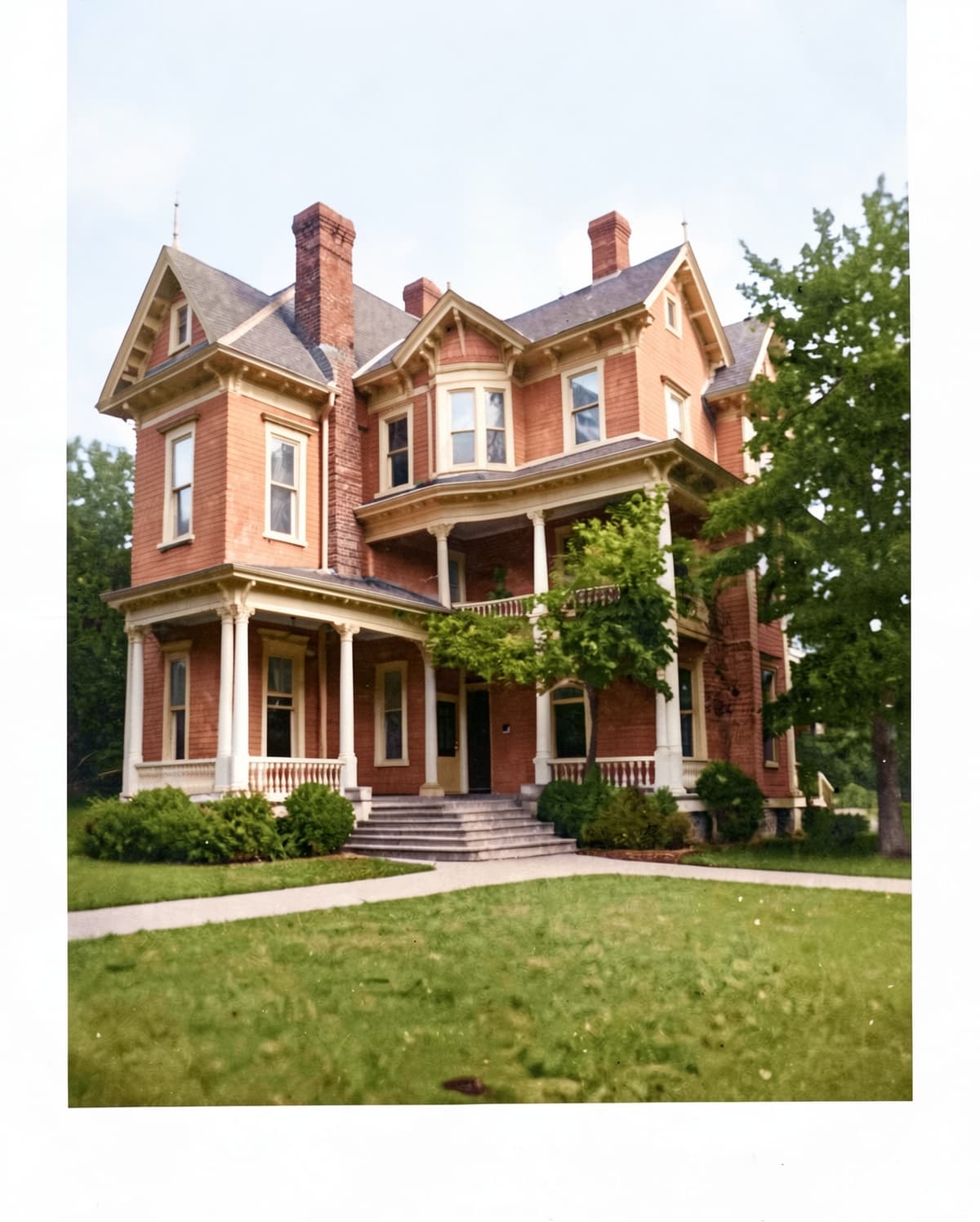
The scanned photograph was loaded into ClearPastAI to see what modern restoration technology could do with a century of accumulated damage.
What ClearPastAI Recovered
The transformation was striking. ClearPastAI's AI engine identified and removed the foxing spots across the entire image without disturbing the underlying photographic detail. Where the spots had overlapped with architectural features, the algorithm intelligently reconstructed the missing information based on surrounding context. The decorative trim along the roofline reappeared. The porch railing pattern became legible again. Even the texture of the clapboard siding, which had been almost invisible under the layer of fading and spots, came back with clear horizontal lines and shadow definition.
Beyond the spot removal, the AI restored the tonal range of the photograph. The sky regained a smooth gradient, the shadows beneath the porch deepened to reveal depth, and the midtones that define architectural form returned to their proper values. The house looked solid again, present and real, rather than fading away into the deteriorating paper.
Why This Restoration Matters
Old house photographs are more than images of buildings. They are records of the places where families gathered, where children took their first steps, where meals were shared around kitchen tables that no longer exist. When the physical structure is gone, demolished or replaced decades ago, the photograph becomes the only surviving evidence that it ever stood at all.
For the family who brought in this particular image, seeing the restored version was an emotional experience. They could finally make out details their grandmother had described but that the damaged print had long obscured: the flower boxes beneath the front windows, the swing hanging from the porch ceiling, the stepping stones leading through the front garden. These small details carried enormous personal significance. They transformed a vague shape on deteriorating paper back into a home with a story.
Architectural heritage photography also has historical value beyond the personal. Photographs of 1920s residential architecture document building styles, neighborhood layouts, and craftsmanship traditions that have largely disappeared from the American landscape. Restoring and preserving these images contributes to the broader historical record of how communities were built and how they evolved over time.
Restore Your Old House Photos Today
ClearPastAI removes foxing, restores faded details, and brings old architectural photographs back to life. Whether it is a family home, a historic building, or a neighborhood that has changed beyond recognition, our AI preserves the image so the memory endures. Try it free on your iPhone or iPad.
Free to try. No account required.