
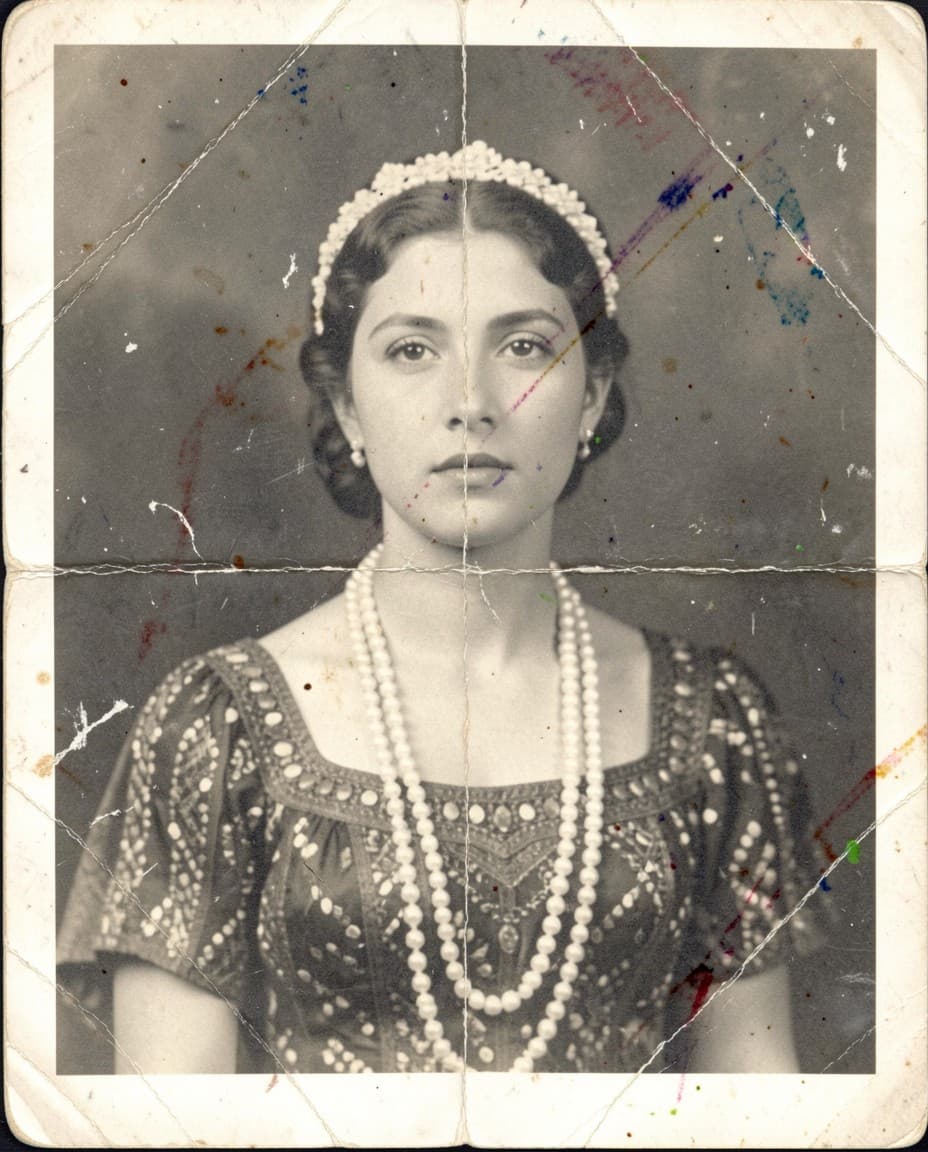
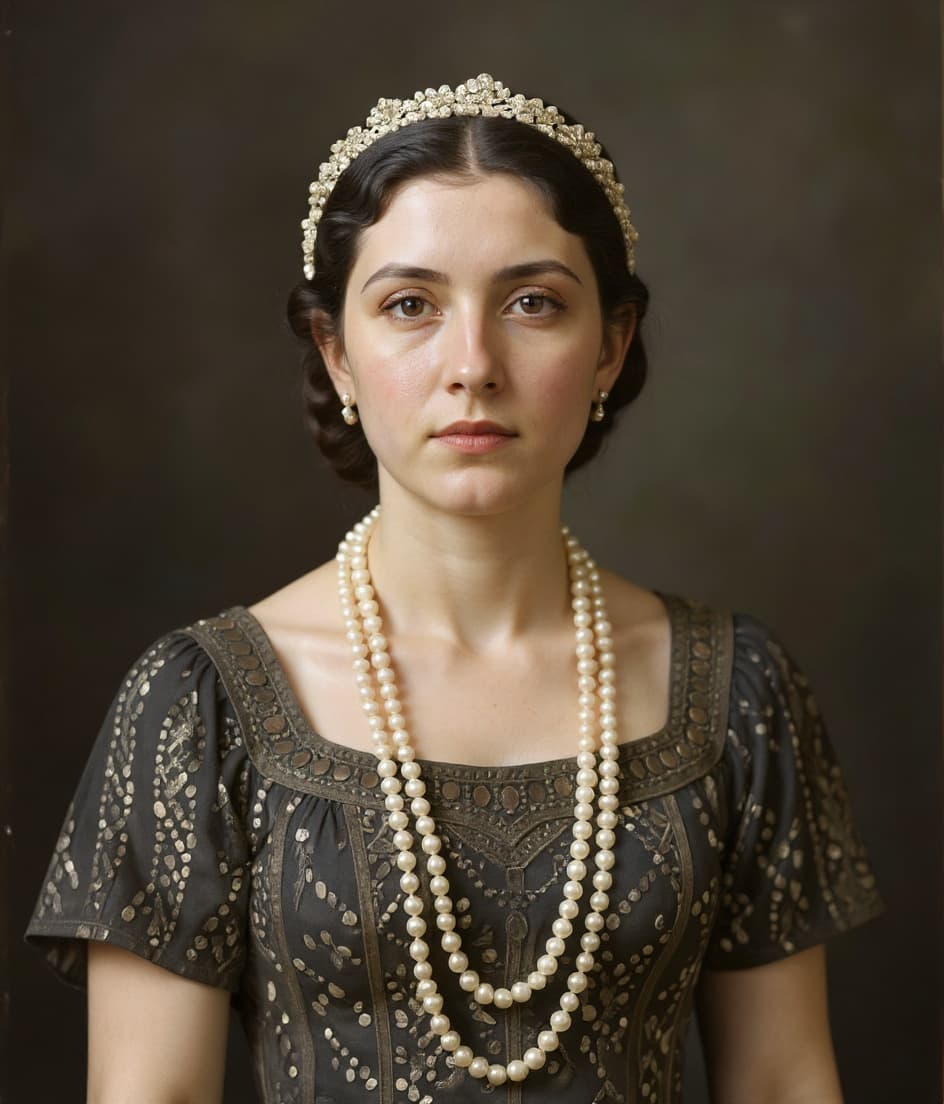
She was someone's great-grandmother, posed in a photography studio sometime in the mid-1920s. A beaded flapper dress caught the studio light. A satin headband held back dark bobbed hair, and a strand of pearls hung low against the bodice. Her chin was lifted slightly, her gaze direct and composed. It was the kind of portrait that cost real money during the Jazz Age, taken at a time when having your photograph made was still an event worth dressing for.
A Century of Damage
The portrait had survived a hundred years, but not without consequences. It had been folded at some point, probably during a move, leaving two vertical crease lines running through the center of the image. One crease cut directly across the subject's face, splitting her expression in two. Deep scratches ran diagonally across the lower half, some of them carrying colored residue, a sign that the photo had been stored against something reactive like old newspaper or colored paper.
Foxing had appeared across the surface, those distinctive reddish-brown spots caused by fungal growth in the paper fibers. The overall gray tones had faded unevenly, with the darker areas losing their depth and the lighter areas blending into the yellowed paper. The paper texture itself had become part of the image, its grain and fiber pattern now as visible as the subject's face. A layer of grime and dust coated everything, dulling whatever contrast remained.
This was not the kind of photo you could fix with a simple contrast adjustment. Every major category of photographic damage was present: mechanical (folds, scratches), chemical (foxing, fading), and environmental (dust, grime). A professional restorer would have quoted several hours of careful work at significant cost.
How ClearPastAI Brought Her Back
The scanned portrait was loaded into ClearPastAI, and the AI immediately got to work on the most critical damage first.
The fold creases were the most structurally damaging feature. The AI traced each crease line and reconstructed the image content beneath it, rebuilding the beadwork on the dress, the smooth skin of the face, and the soft gradient of the studio backdrop that the folds had interrupted. The crease that had cut across her face was filled in with remarkable accuracy, restoring the continuity of her expression without creating any uncanny distortion.
The deep scratches with their colored residue were identified and removed layer by layer. Rather than simply painting over them with a flat tone, the AI reconstructed the underlying detail, including the intricate bead pattern on the dress that the scratches had obscured. The foxing spots were eliminated cleanly, without leaving behind the soft halos that often result from manual spot removal.
The tonal range was rebuilt from the ground up. Deep, rich blacks returned to the shadows. The highlights regained their brightness without blowing out. The full range of gray tones in between was restored, bringing back the three-dimensional quality that made studio portraits of this era so striking. The paper texture and surface grime were suppressed, letting the actual photographic image come forward again. You could finally see the light catching the pearls, the texture of the beadwork, and the confident clarity in her eyes.
Why This Matters: Faces From History Deserve to Be Seen
A portrait like this is more than a family keepsake. It is a window into who someone was at a particular moment in time. The care she took choosing that dress, the way she held herself for the camera, the decision to sit for a formal portrait at all, these details tell a story about a woman who lived through one of the most dynamic decades of the twentieth century. When damage obscures that image, it obscures her story.
Vintage portraits from the 1920s and earlier are among the most fragile photographs in any family collection. The paper stock, the chemical processes, and the sheer passage of time all work against preservation. Many families have portraits like this tucked away, too damaged to display but too meaningful to throw away. AI restoration gives these images a second life without requiring the original to be handled further or sent away for weeks of professional work.
Restore Your Vintage Portraits
ClearPastAI can handle even severely damaged vintage photographs. Whether your family portrait is from the 1920s or the 1990s, our AI restores detail, removes damage, and brings faces back to life. Try it free on your iPhone or iPad.
Free to try. No account required.